Why Does Someone with Dementia Keep Repeating the Same Question?
Repeating the same question is common in dementia and isn't usually deliberate. Learn why it happens, what the person may be trying to communicate, and how calm, compassionate responses can help.
Oct 1, 2026
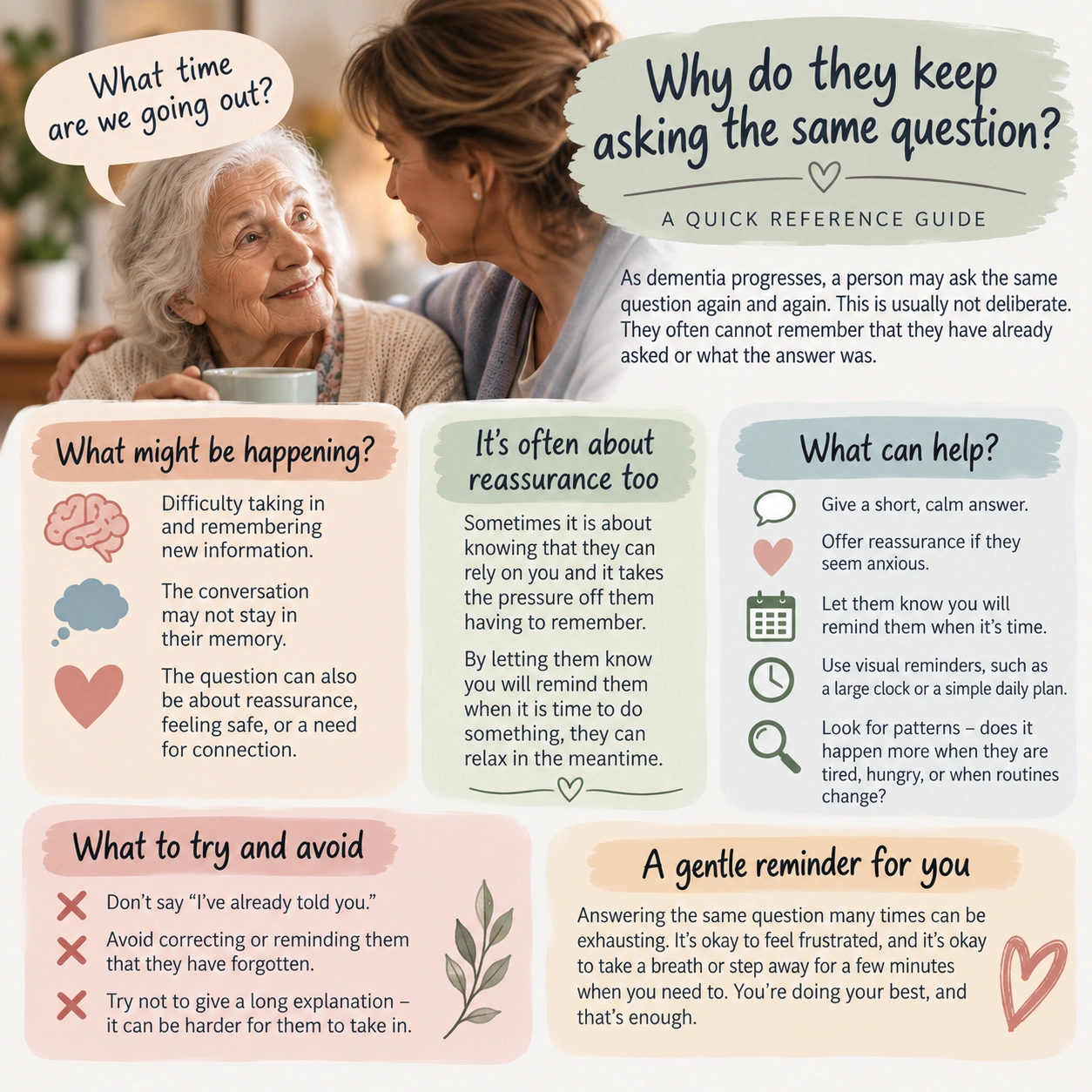
One of the things many families notice as dementia progresses is that the person they love may start asking the same question over and over again.
It can be frustrating, especially when you have already answered the question several times. And that frustration is completely understandable. Caring for someone with dementia can test even the most patient person.
But it can help to remember one important thing:
They usually aren't deliberately repeating themselves.
They May Genuinely Not Remember Asking
Dementia can affect a person's ability to take in and retain new information. While they may have a very clear memory of something that happened many years ago, something you have just told them may not stay with them.
So when they ask the same question again, they may genuinely believe they are asking you for the first time.
From your perspective, the conversation has already happened.
From their perspective, it may not have.
That small difference can make a big difference in how we respond.
Sometimes the Question Is Really About Reassurance
Repeated questions aren't always simply about forgetting.
There may be an emotion or need underneath the question.
For example, someone who repeatedly asks, "When are we going home?" may not only be asking about a time or destination. They may be feeling confused or unsettled and looking for reassurance that they are safe and that someone is there to help them.
Someone repeatedly asking when their daughter is coming may simply be missing her.
Someone asking what is happening next may feel anxious because they don't understand what is happening around them.
Instead of listening only to the words, it can help to ask yourself:
What might they need from me right now?
Sometimes they need information.
Sometimes they need reassurance.
And sometimes they simply need to know that they can rely on you.
How You Respond Can Make Things Easier
It can be tempting to give a long explanation, hoping that this time they will remember.
Unfortunately, that may not work.
A short, calm answer is often easier for someone with dementia to process.
If they seem worried, add reassurance. Sometimes the reassurance is more important than the actual answer.
You might say:
"We're going home after lunch. You're safe, and I'm here with you."
Keeping your response simple and reassuring can help reduce unnecessary stress.
Try Not to Turn It Into a Battle
It is easy to become caught in a cycle of answering, correcting, explaining and becoming increasingly frustrated.
But reminding someone that they have already asked the question may not help them remember. Instead, it may leave them feeling embarrassed, confused, angry or frustrated.
This doesn't mean you have to pretend the repetition isn't exhausting.
It can be exhausting.
It simply means recognising that the person isn't necessarily choosing to make things difficult.
Their brain may genuinely be struggling to hold onto new information.
Look for When It Happens
It can also be useful to notice whether there is a pattern.
Ask yourself:
Does the repetition happen more when they are tired?
Does it happen more in the late afternoon?
Are there lots of people around?
Has their normal routine changed?
Is an appointment or visitor coming?
Could they be hungry, uncomfortable or anxious?
Sometimes the repeated question is a clue that something else is happening.
Someone repeatedly asking what time dinner is might actually be hungry.
Someone repeatedly asking when their daughter is coming might be lonely.
Someone repeatedly asking where they are going might be feeling uncertain about what is happening.
You don't always have to solve the repetition.
Sometimes understanding it is enough to change how you respond.
A Little Kindness for the Carer Too
There is another side to repeated questions that deserves attention: the caregiver's experience.
There may be days when you simply cannot face answering the same question another twenty times.
You may feel irritated.
You may snap.
You may need to walk away for a few minutes and take a breath.
That doesn't make you a bad carer.
It makes you human.
Caring for someone with dementia can be relentless, and patience isn't something any of us have an endless supply of.
If you can, give yourself permission to pause.
Ask someone else to take over for a little while. Go outside. Have a cup of tea. Take a breath.
You don't have to get every response right.
Remember What Is Happening for Them
The next time the same question comes around again, it may help to remind yourself:
They aren't necessarily giving you a hard time. Their brain is having a hard time holding onto the information.
They may not remember the conversation you have just had.
They may be looking for reassurance.
They may be confused or anxious.
Or they may simply need to know that someone is there.
Meeting them where they are, rather than expecting them to remember what they used to remember, can make these moments a little easier for both of you.
And if today you answered the same question ten times and managed to stay patient for nine of them, that's okay too.
You're doing the best you can in a situation that neither of you chose.
A Gentle Reminder from The Memory Nest
Repeated questions can be challenging, but behind the repetition may be a person who is confused, anxious, lonely or simply trying to feel safe.
Respond to the need, not just the question.
And remember to show yourself the same compassion you are trying to give your loved one.